Showing posts with label Exhibitions. Show all posts

Thursday, 25 October 2012

The Lost Prince: the Life & Death of Henry Stuart


Henry Stuart was the eldest son of King James VI/I, the Prince of Wales and heir to the throne. He showed great promise as a young man, and many people pinned great hope upon him, but at the age of 18 he died. And that should have been the end of it. But his position as heir to the throne was inherited by his young brother Charles, an altogether less promising young man. Charles went on to be a controversial king, whose reign ended in a civil war fought against Parliament, and in his own capture and execution. And so the death of young Henry can be seen as one of those "What if??" moments. What would have happened if Henry had lived? Would the monarchy and parliamentary democracy have evolved in the same way?

But from the point of view of an exhibition in what is after all an art gallery, Henry's death marks another great moment of change. There are some exquisite paintings here, paintings by established artists such as Nicholas Hilliard, Isaac Oliver and Robert Peake, working in a style that is still recognisably that of the era of Queen Elizabeth I, and of Henry's parents James VI/I & Anne of Denmark. Who knows whether Henry would have become a great patron of the arts, but his young brother Charles certainly did. Barely 8 years later, Van Dyck paid his first visit to England and the court of King James. He was to return after another decade to portray the glamorous but doomed court of King Charles I. The paintings that capture the life of Henry and the young Charles are so different to those that would depict the later life and court of Charles as king.

This is a great opportunity to immerse yourself in early Stuart art.

18th October 2012 - 13th January 2013

Thursday, 3 February 2011

Salisbury Cathedral


Water Towers - an Illuminated Musical Maze by Bruce Munro, until 27th February 2011

If you need any other reason to visit Salisbury Cathedral, apart, that is, from the beauty of this magnificent 13th century building, or the presence in the Chapter House of an original Magna Carta, then Bruce Munro's installation certainly adds a certain something!
Arranged around two sides of the cloister are 69 towers of plastic water bottles, 15,000 bottles in total. Each tower of bottles is lit by fibre optics, and the colours move and change to a soundtrack of choral music. Munro was inspired by reading about synesthesia, a condition in which some people experience sound as literally having colour, but it has also been commented that the installation is reminiscent of light falling through the stained glass windows of a cathedral.
We arrived late afternoon, while it was still quite light. The colours in the bottles were only just discernible, and the installation looked like nothing more than rather a lot of water bottles, so we repaired to the cafe for coffee and cake.
As the light waned, so the sculptures took on a new life - the colours began to appear, delicate at first, but as it darkened so the colours became richer and more vibrant. Walking between them was a rich experience of music, colour and light to equal anything one might have seen INSIDE the cathedral.
The cathedral is generally open until 6.15pm, and there are a number of late openings during the next three weeks. Salisbury is very easy to reach from London by train or bus.

Saturday, 29 January 2011

Modern British Sculpture at the Royal Academy of Arts


The Royal Academy of Arts is one of London's most venerable art institutions, dating back to 1768 when it was founded by a group of prominent artists and sculptors, including Sir Joshua Reynolds, to enhance their professional standing. Alongside this, they also established a school for artists, and a space for exhibitions.
Today the Royal Academy has a programme of changing exhibitions, as well as smaller displays from their permanent collection, which includes Michelangelo's Taddei Tondo. It's Summer Exhibition is unique, bringing together a large assortment of contemporary work from both known and unknown artists. Its current exhibition of Modern British Sculpture, now showing until 7th April 2011, is one not to be missed.
My favourite parts of the exhibition are the early rooms. The first looks at two works by Edwin Lutyens and Jacob Epstein, and invites you to think about the process of design and creation for architectural settings in London - the Cenotaph on Whitehall and the BMA building (now Zimbabwe House on the Strand).
The second room leads you to think about sculpture in the way a sculptor might, and particularly a sculptor working during the early decades of the 20th century. The Royal Academy has assembled many examples of sculpture from cultures separated by time and distance from early 20th century Britain, but which were a source of inspiration to artists working here because they could be seen in collections such as the British Museum. The sculptor's preoccupation with material, technique, line, surface pattern, the fall of light, volume, weight, balance, narrative, portraiture, the depiction of ideas and beliefs - all these can be explored through both the new(-ish) and ancient sculptures on display here.
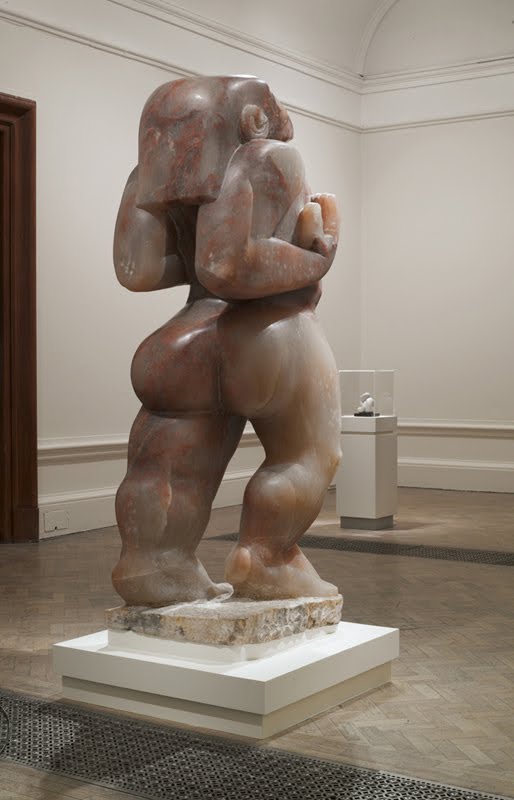
I found this second room particularly inspiring, and it led very naturally into a third room dominated by one piece that was almost entirely alone, Epstein's stunning Adam. Massive, unmissable, one can still imagine the intake of breath with which it was greeted when first created. For me, this piece seems to draw together all the strands of thought behind sculpture of the early C20; its power and presence is equalled only by Picasso's Guernica. It has had a difficult journey through life, ending up recently at Harewood House, but I can't imagine a more effective way to display or understand it than its present position at the RA.
Tiny, in a corner, was a snake by Henry Moore; certainly the snake belonged in the room, having shared Eden with Adam, but I couldn't help wondering at its smallness, and at the relationship between Epstein and Moore, particularly as I moved into the room occupied by two splendid works by Henry Moore and Barbara Hepworth. After the power and impact of Adam, somehow these two seemed to me to be empty exercises, beautiful in form but lacking in emotion. For a moment I wondered how it was that Henry Moore, rather than Epstein, had become the great name in British 20th century sculpture. But, time to readjust; British sculpture was moving on, captured here in Moore's Festival Figure and Hepworth's beautiful Single Form.
I've seen work by Anthony Caro that I've liked better. Richard Long always looks out of place in a gallery. Damien Hirst's Let's Eat Outdoors was reminiscent of a summer picnic, but thoroughly horrible to look at. My interest waned, which is not to say that someone else might not have preferred the newer works.
The Royal Academy is on Piccadilly; the nearest underground stations are Green Park & Piccadilly. It is open daily from 10am-6pm (10pm on Fridays). The Modern British Sculpture exhibition runs until 7th April 2011. I hope the RA, and the owners of the sculpture, will not mind me using their photos as illustrations.

Wednesday, 17 February 2010

Irving Penn exhibition at the National Portrait Gallery in London


An exhibition of the work of photographer Irving Penn opens at the National Portrait Gallery on 18th February. The gallery has chosen to assemble a collection of portraits of the great & the good in the 20th century arts world, photos that are a visual treat, often elegant and striking.
Interestingly, this selection gives the impression of a photographer who chose to impose his own style upon a portrait rather than to analyse the character of his sitter. For someone like me who was not already familiar with Penn’s work, it was good to be able to look as well at the books on offer in the shop, to see the rich variety of his work not represented here.
Well worth a visit, and of course there is so much else to see in this wonderful gallery.